

There are many families who believe that in Spain there should be a compulsory subject of Financial Education at school. Proof of this is that when a person is getting older and starts working, he or she hardly knows the alternatives that exist to manage his or her income well.
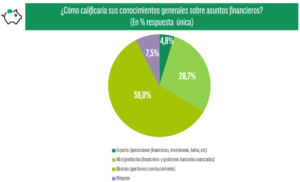
According to the latest July report from the Cetelem Observatory, only 4.8% of Spaniards have advanced financial knowledge. This means that the majority of citizens manage their finances in a similar way due to a lack of knowledge.
Source: Cetelem Observatory
Almost 3 out of 10 Spaniards claim to have “high” financial knowledge and 59% recognize that they have basic knowledge, such as knowing how to manage their current account and little more.
The risk that the majority of the population barely has a basic idea of managing money lies in the fact that ignorance makes you more manipulable. But also, the danger lies in the fact that every month a payroll of €1,500 arrives in their current account. That is to say, every month they have to manage €1,500 properly. Let alone if one day they win Euromillions and have to manage 32 million. If a family does not have a minimum of knowledge, the best thing to do is to work hand in hand with a qualified financial advisor to put things in order. And the lower the income, the more important it is to manage and make the money profitable.
You may think that you don’t earn what you should, but that income has to be structured in such a way that, on the one hand, it allows you to pay all your monthly expenses. But it also has to be enough to create a cushion to cover oneself and protect oneself in case of unforeseen events. If you do not have that protection , the easy and inevitable solution is to get into debt with personal loans that are sold to you with the supposed advantage of being able to pay them back in “very comfortable” installments but with huge interest rates, which reduce the economic health of your family.
The first step is to draw up a realistic budget of income and expenses for the next month and write down each expense scrupulously. Once we are clear about how much money we earn and how much we spend, we will know how much money we have left so that we can use it to save for unforeseen events and to plan to meet all the objectives we have ahead of us.
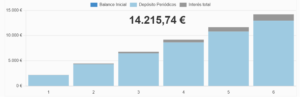
90 per month at a return of 3% per annum in 6 years’ time
If on the day their child is born, the same couple were to allocate 75 € each per month for their university studies to a plan with an annual return of 9%, this would be the result 18 years from now
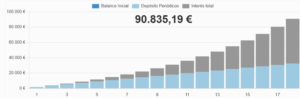
Don’t underestimate the power of saving little by little every month 75 €, because in a few years, you can have much more than you can imagine to give your children the education they deserve.


